
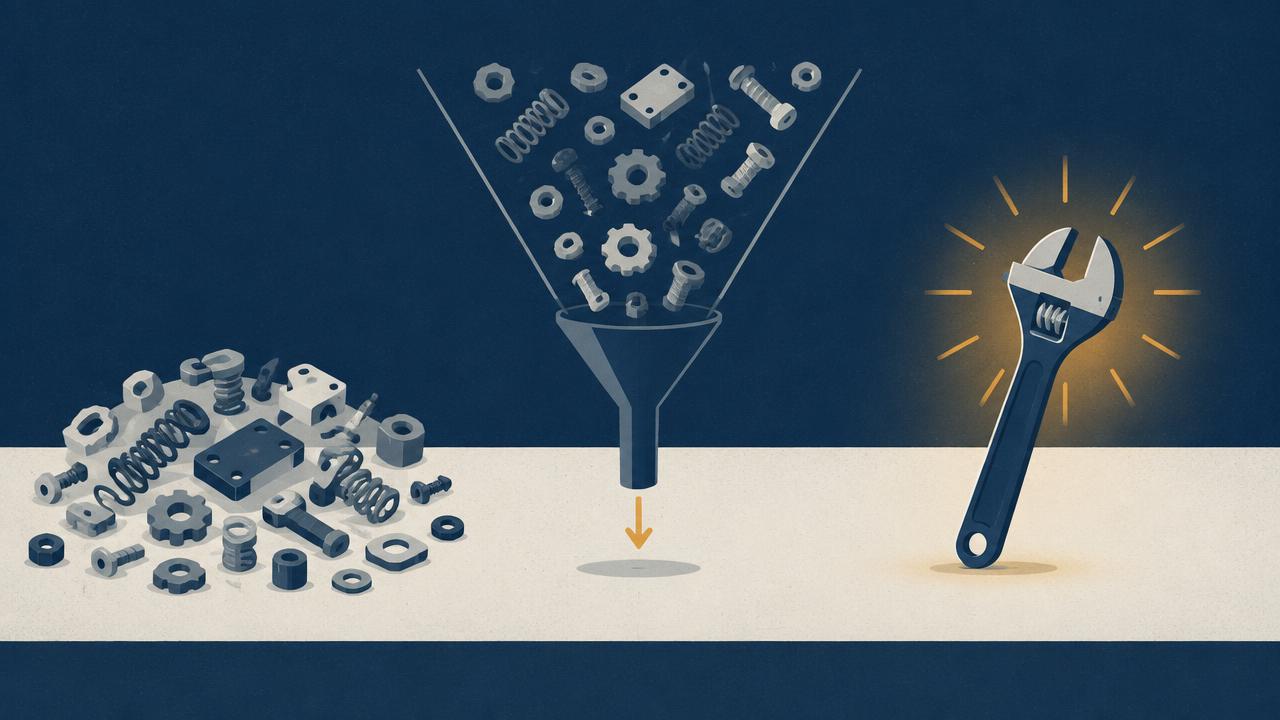
From Feature List to Offer: How to Say What the Customer Actually Gets
Refining IdeasSeptember 6, 2026
The Charlie Page Letter
26 years of experience and common sense delivered to your inbox.
A feature list describes the maker's work. An offer describes the buyer's change. The translation between them is the single most valuable sentence in your business, and most founders never write it down, so the buyer has to do the work themselves.
I've done this badly. My first sales pages were honest inventories: everything included, everything accurate, nothing that made a tired reader think "that's my week". The version that finally sold was shorter, vaguer about mechanisms, and precise about outcomes.
The reason the translation matters so much is that strangers don't evaluate your feature list, they imagine their own week with your thing in it. If they can't run that simulation in five seconds, they leave, and no amount of detail brings them back.
Why doesn't a feature list sell?
Because it asks the buyer to do the conversion. They have to work out which feature matters, what it saves, and whether it's worth the price. Most won't bother, because the alternative to effort is closing the tab.
It also invites comparison on the wrong axis. A list of components invites a list of components back, and the buyer ends up comparing counts rather than value. That's how a better product loses to a more legible one.
And features are inherently self-referential. They tell you what the builder thought was hard, which is rarely the same thing the customer thought was worth paying for.
How do I find the outcome behind a feature?
Ask "so what" twice. The reminder feature so you don't forget the task, so you stop apologising to clients. The second answer is the sale. The first answer is still a feature wearing a coat.
Use the buyer's own words when you can. If they say "I dread the end of the month", the outcome is "the end of the month stops being a scramble". Borrowing their phrasing is the cheapest copywriting there is.
If you can't get to a second "so what", the feature may be for you rather than them. That's worth knowing, because those are exactly the features that get removed in the refining pass and nobody notices.
What does a good offer sentence look like?
One outcome, one person, no mechanism. "Your invoices go out on time without you remembering to send them, for freelancers with repeat clients." Notice there's no mention of how, and no mention of the software.
It should feel slightly too simple to be the whole truth. That's normal. Founders over-explain because they're afraid of understating the work, and understating is what makes a promise easy to hold.
Put it at the top of everything, and if the rest of the page doesn't serve it, the rest of the page is a feature list in disguise.
Where do features belong then?
Below the fold, as evidence. Once someone believes the outcome, the list answers the second question: is this real, how does it work, what am I actually getting. Features are proof, not the pitch.
Order them by which one removes the biggest fear. The buyer reading your list is not admiring you, they're checking whether you've thought about the thing that went wrong last time.
And cut the ones nobody asks about. If no prospect has ever mentioned a feature, it isn't a selling point, it's a maintenance cost.
How do I test the translation?
Say the outcome sentence to someone with no context and ask what they think happens next. If their guess resembles your product, the translation worked. If it doesn't, you've invented a phrase only you understand.
Then say it to a stranger with the problem and ask what they'd want to check before paying. Their list of doubts is your real page, and it will not be the page you'd have written.
Finally, have the whole thing checked by something with no stake in your feelings. A free pressure test reads the customer, the outcome, the price, and the reach and tells you which link is weakest. Keep each version in My Tests as the sentence gets sharper.
What's the fastest way to get better at this?
Write five outcome sentences in one sitting and pick the one that makes you slightly nervous, because that's usually the one that's specific enough to be believed. Volume helps, and so does the mild fear of being wrong in public.
Read what your customers write about their own work. Their phrasing beats yours every time, and a page built from their sentences reads like someone who has actually listened.
Then run the pass regularly. Offers drift back toward feature lists, because building adds features and features are easy to mention. Once a quarter, cut the page back to the sentence and add only what the sentence needs.
The customer isn't buying your features, they're buying a different week. Say what the week looks like, and keep the list underneath as proof that you can deliver it.
Test your sentence against the free pressure test, then read how to refine an offer for the removal passes that make the promise impossible to miss.
Frequently asked questions
The Charlie Page Letter
26 years of experience and common sense delivered to your inbox.