
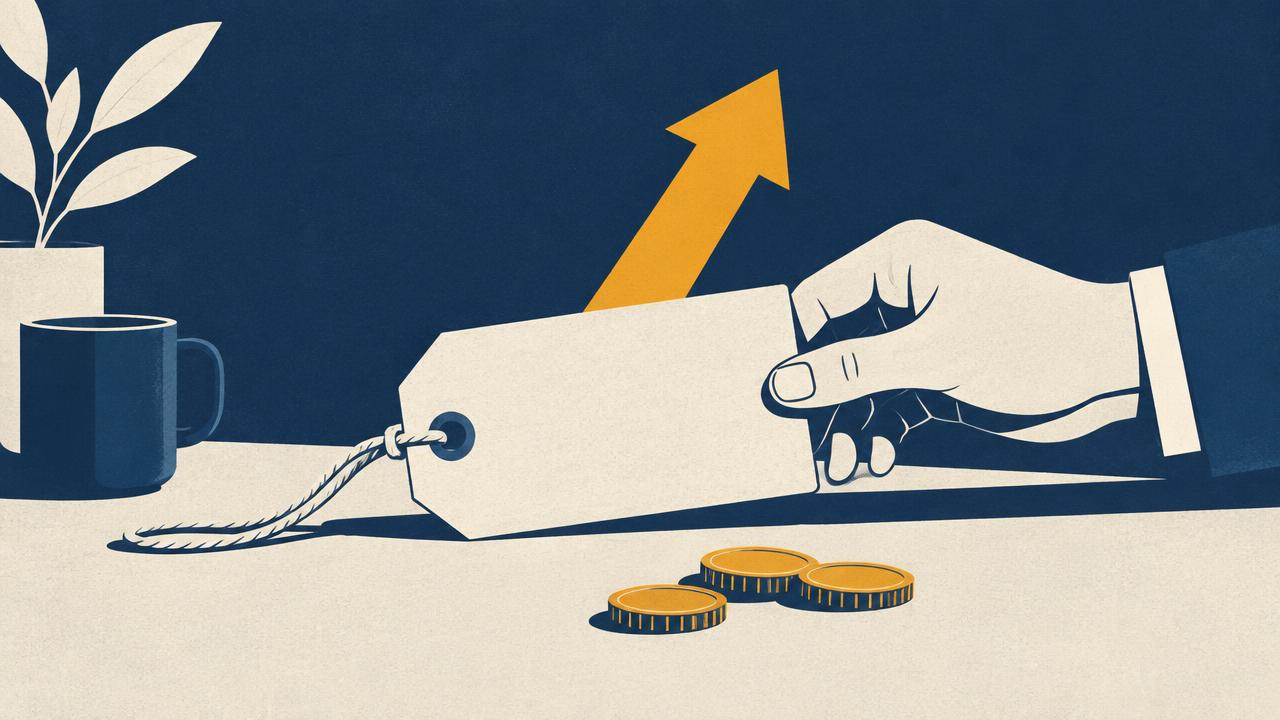
How to Raise Your Prices Without Losing Sleep
Refining IdeasSeptember 8, 2026
The Charlie Page Letter
26 years of experience and common sense delivered to your inbox.
Raise your prices by changing them for new customers first, saying the number without apology, and giving existing customers a clear reason and a deadline. The sleep loss comes from treating it as a confession rather than a decision.
I've underpriced more than once, and in every case the low price wasn't buying me customers. It was buying me relief from the fear of hearing no. The work still came in, the resentment still built, and the business stayed small because there was never enough margin to fund growth.
The other thing I've learned is that price is the easiest lever in a small business and the one people touch last. New offers, new channels, and new tools all take months. A number changes in a sentence.
How do I know my price is too low?
Three signs. Every sale is a struggle to justify, you can't afford to find the next customer, and you feel quietly resentful when someone asks for a discount. Any one of those is a symptom; all three mean the number is wrong.
The arithmetic test is simpler. Take one sale and subtract the delivery hours, the tools, and the cost of winning the next one. If what's left is thin, you're not running a business, you're running a job with a marketing budget.
The tell that founders miss is that the price feels like a secret. If you'd rather not say it out loud, you already know it isn't the price you'd defend.
What should the new number be?
Price against the buyer's alternative, not against your effort. What do they pay a contractor, an agency, or a stack of subscriptions? What do the wasted hours cost them? A number obviously smaller than that is easy to say and easy to accept.
Then check the margin math at the new price: does one sale fund the next customer? If not, keep going up, or change what's included, because a price that can't fund marketing is a slow form of failure.
Aim for a number you could say twice without flinching. If it makes you slightly nervous and you can still justify it in one sentence, it's probably about right. If it makes you want to hide, you've overshot the argument you can actually make.
Who should I raise prices on first?
New customers. They have no anchor to compare against, and the change costs you nothing with people who've already paid. This is the single least painful way to correct a price, and founders delay it for months for no reason.
Then, when you have the nerve, existing customers with a date attached. Give them the old price until a specific day, or keep it for a defined period, and tell them plainly. Most people accept a change far better than they accept a surprise.
Do not raise prices quietly. A customer who finds out at invoice time will feel handled, and a customer who was told three weeks ago will mostly stay.
What do I say when someone objects?
Nothing apologetic. State the price, then stop talking. Most of the pain in a price conversation comes from filling the silence with justification, which turns a confident number into a negotiation you didn't ask for.
Then find out what the objection really is. "Too expensive" can mean no budget, no belief it works, or a comparison to something you didn't know about. Only the first one is a pricing problem, and the other two are fixed by proof or by a smaller starting step.
It's fine to offer a cheaper version of the offer, with less inside. It's not fine to offer the same thing for less, because that tells the buyer your first number was theatre.
What if everyone refuses the new price?
Then you've learned something cheaply, and the honest question is why. Either the outcome isn't valuable enough to them, or you haven't shown the proof that would make it credible, or you're talking to the wrong person.
Check the customer before you check the number. The same offer that's expensive for a beginner is trivial for someone whose income depends on it, and moving upmarket is often a one-line change in who you're speaking to.
If the price ceiling is genuinely hard, the market is telling you the offer needs a bigger outcome or a different problem. Volume is the last resort and rarely works, because buying each customer costs money you don't have.
How do I get comfortable saying it?
Say it out loud five times before the conversation, including once to someone who will not be a customer. The discomfort is a habit rather than a signal, and habits fade with repetition.
Write the one sentence that justifies it, and memorise only that. Any more than one sentence and you'll start selling rather than stating, and buyers notice the difference immediately.
And get the whole thing checked before you commit to it. A free pressure test will tell you whether the price the market would accept is even high enough to matter, and where the critical weakness sits. Keep the improved version in My Tests and re-run it after you change the offer.
A price you can't say comfortably isn't a modest price, it's an undecided one. Decide it, say it once, and let the market answer.
Check whether your price and your reach hold together with the free pressure test, then read from feature list to offer to make sure the buyer can see what they're paying for.
Frequently asked questions
The Charlie Page Letter
26 years of experience and common sense delivered to your inbox.